





|
Getting your Trinity Audio player ready...
|

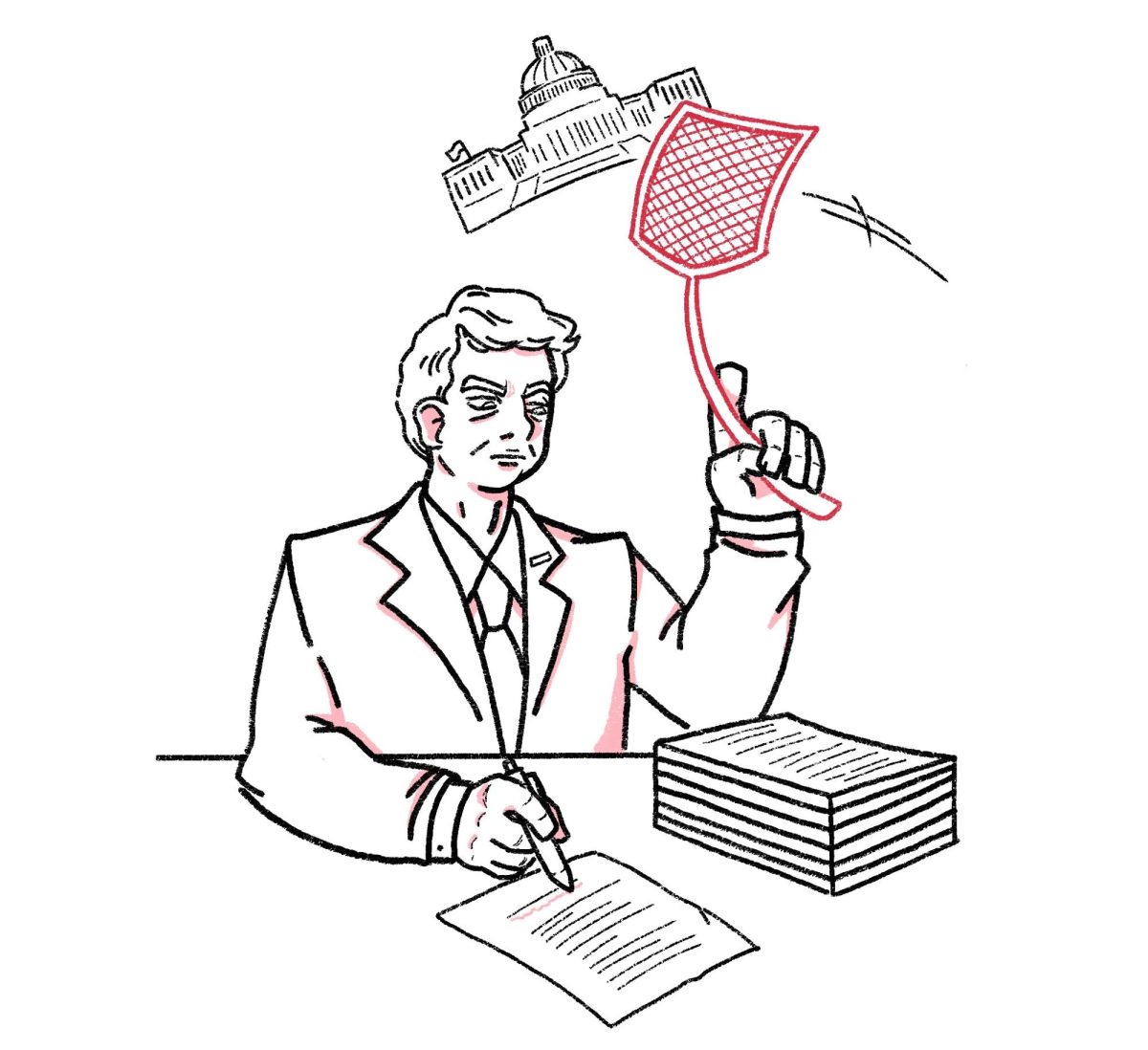
Change has been brought to America—rightly or wrongly.
Since the beginning of the year, deportations have doubled, protests have filled our streets, and troops have patrolled our cities against the will of state officials.
This sudden rise in deportations is simply a direct reflection of Trump’s policies. In November 2024, he declared that he would “launch the largest deportation program of criminals in the history of America.” Since then, he has imposed much higher quotas—tripling previous targets—and rescinded a Biden-era policy that protected certain areas, such as schools and places of worship, from ICE enforcement.
In June, protests in Los Angeles and nearby cities erupted into violence: police fired tear gas and rubber bullets to disperse demonstrators, as rioters looted stores and set cars ablaze. Citing “lawlessness,” Trump deployed the National Guard to the Los Angeles area.
In total, 2,000 National Guard troops were sent to Los Angeles. Around 700 marines were deployed to Los Angeles as well. However, both California governor Gavin Newsom and Los Angeles mayor Karen Bass did not authorize the deployment.
Trump’s actions were later ruled unlawful by a federal judge.
In the ensuing controversy, 22 Democrat governors released a joint statement, describing the deployment as an “alarming abuse of power.”
On social media, Newsom went further, calling the deployment “the acts of a dictator, not a president,” and that “Democracy is under assault before our eyes.”
The deployment marked the first time since 1965, when Lyndon B. Johnson deployed a state’s National Guard without the governor’s approval.
Trump has since moved to deploy the National Guard to other Democratic-led cities, including Portland, Chicago, and Memphis, claiming these actions are meant to reduce crime and support immigration enforcement. In Portland and Chicago, however, federal courts have blocked or restricted those deployments, while Guard troops are currently patrolling parts of Memphis.
This approach runs up against the Posse Comitatus Act, which is meant to prevent the federal government from using the military as a domestic police force except in very narrow circumstances.
While the protests in Los Angeles were chaotic, local law enforcement was capable of handling the situation and did not prevent ICE from carrying out its duties, undercutting any legitimate rationale for a federalized military response.
The Posse Comitatus Act “stands for the idea that we separate military and civilian affairs in the United States,” which is an essential American value, according to Director of the Law and Public Policy Minor at Northeastern University Dan Urman.

While sanctuary cities limit cooperation with ICE, they themselves do not prevent them from doing their job. One may have their own opinion on “sanctuary city” policies, but in short, they are not illegal, because local authorities do not have to aid ICE in their operations.
If agent safety were the real concern, troops would provide targeted security during ICE operations, not patrol city streets indefinitely. The Posse Comitatus Act exists precisely to prevent presidents from using “federal interest” as justification for military intervention in local policing.
Trump’s National Guard deployments are not carried out simply to protect ICE operations, but rather to take over the responsibilities of local law enforcement in Democratic cities.
In other words, he seeks greater control over their policing and labels their local law enforcement as ineffective to justify his actions, blurring the line between legitimate federal support and an attempt to federalize local policing.
To be clear, Trump’s deployments are also highly inefficient and ineffective at preventing crime. In Washington, D.C, for example, the deployments of D.C. national guard are expected to cost over $200 million.
Additionally, National Guard troops in D.C. have been seen almost exclusively near tourist areas and monuments, rather than the city’s high-crime neighborhoods, suggesting that they are a mere display of power.
In Chicago, the pattern is similar. Despite Trump’s claims that deployments have drastically helped to drop crime, they have been ineffective. Additionally, Chicago’s crime rate had already been declining before the deployments.
The recent deployments also highlight Trump’s neglect of low-income neighborhoods in favor of high-income communities, even when those communities do not need his support. Simply put, Trump’s actions represent a significant misallocation of resources.
In short, National Guard deployments would be necessary if states or cities were actively obstructing ICE operations. While tensions remain high, no such obstruction has occurred, and a lack of cooperation by local police does not warrant the deployments.
Instead, Trump’s recent deployments are an unjustified act of intimidation against his opponents and a slap in the face to American democracy and freedom. The question is no longer whether the National Guard deployments are “tough on crime,” but whether they test our country’s limits.